






In the agri-food sector, the controlled presence of pesticide residues in fruits, vegetables and other plant matrices is a critical aspect for both food security and access to national and international markets. Multi-residue analysis using advanced techniques such as gas and liquid chromatography coupled to mass spectrometry (GC-MS/MS and LC-MS/MS) has established itself as the technical standard to ensure regulatory compliance and product quality.
Current regulatory framework in Spain and the European Union
The control of pesticide residues in food is strictly regulated at European level, being directly applicable in Spain.
The main legal framework is Regulation (EC) No 396/2005, which sets maximum residue levels (MRLs) for pesticides in food and feed of plant and animal origin. These regulations:
- Defines maximum allowable levels for hundreds of active substances
- Ensures consumer health protection
- It is updated regularly based on toxicological evaluations and new scientific data
In addition, Regulation (EU) 2017/625 regulates official controls, requiring food operators to have self-control mechanisms in place to ensure compliance with MRLs.
At the national level, Spain annually develops the Official Control Program for Pesticide Residues, coordinated by AESAN, which establishes sampling and analysis plans for plant products.
In addition, for export, it is common for products to comply with additional requirements from third countries (e.g. USA, Japan or UK), which may set their own or more restrictive MRLs.
Importance of multi-residue analysis
Plant products are exposed to multiple phytosanitary treatments throughout their production cycle. As a result, they may contain residues of different active substances, even at very low concentrations.
Multi-residue analysis allows:
- Simultaneously detect hundreds of pesticides in a single determination
- Verify legal compliance with MRLs
- Prevent commercial rejections and health alerts (RASFF)
- Controlling the correct application of phytosanitary products
- Ensuring the traceability and safety of the food chain
It is, therefore, an indispensable tool for producers, exporters, supermarkets and the agri-food industry.
Parameters and substances analysed
The concept of "multi-residue" implies the simultaneous determination of a broad spectrum of active substances belonging to different chemical families:
1. Insecticides
- Organophosphates
- Pyrethroids
- Neonicotinoides
2. Fungicides
- Triazoles
- Strobilurins
- Dithiocarbamates (in specific methods)
3. Herbicides
- Glyphosate (requires specific method)
- Chlorophenoxyacetics
- Other polar compounds
4. Growth regulators and other compounds
- Various active substances used in intensive agriculture
Analytical techniques used
Modern multi-residue analysis is based on the combination of chromatographic separation techniques with highly sensitive and selectivity mass spectrometry.
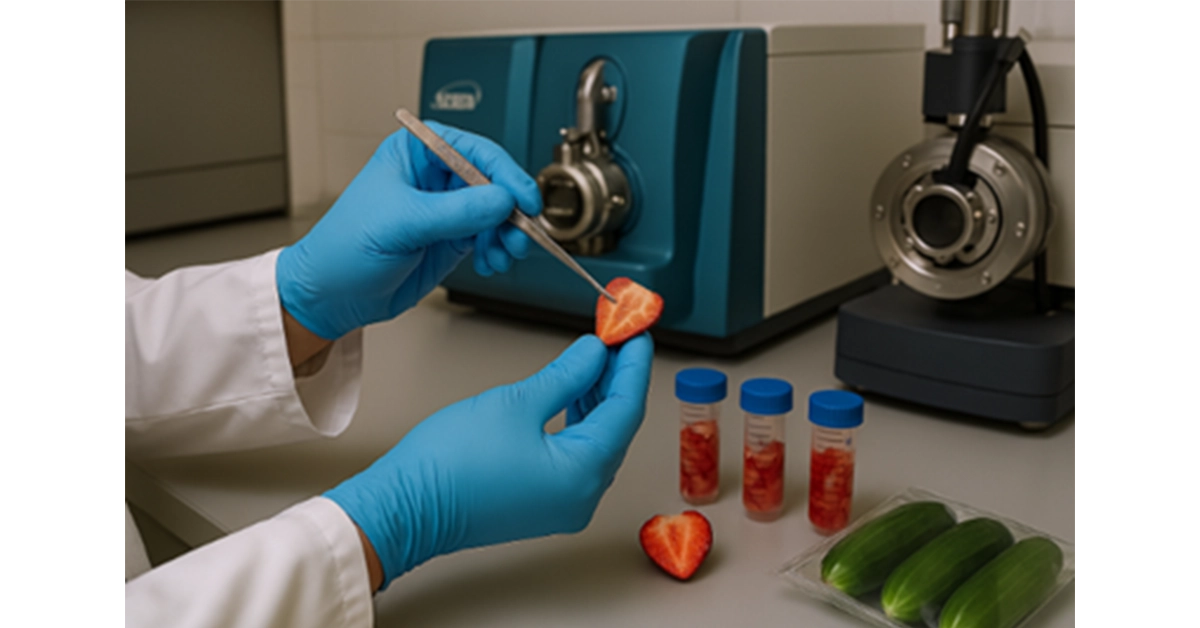
1. Liquid chromatography coupled to mass spectrometry (LC-MS/MS)
- Ideal for thermo-labile and polar compounds
- High sensitivity (μg/kg levels or lower)
- Broad spectrum of modern pesticides
2. Gas chromatography coupled to mass spectrometry (GC-MS/MS)
- Suitable for volatile and semi-volatile compounds
- Excellent resolution for classic insecticides
- Very robust and reproducible
3. Sample Preparation: QuEChERS Method
The QuEChERS (Quick, Easy, Cheap, Effective, Rugged and Safe) method is the standard for extraction:
- Enables fast and efficient preparation
- Adapted to complex matrices such as fruit and vegetables
- Supports multi-residue analysis
Interpretation of results
Analytical results are generally expressed in mg/kg (ppm) and compared with the MRLs established by legislation.
Interpretation includes:
- Legal compliance/non-compliance
- Evaluation of unauthorised substances
- Multi-residue matching analysis
- Evaluation of trends in crops or suppliers
In a commercial context, even levels below the MRL can be critical if the customer demands more restrictive values (e.g., MRL = 0.01 mg/kg).
Fitosoil: comprehensive multi-residue analysis service
Fitosoil offers a complete and highly specialized service for the analysis of pesticide residues in plant matrices, adapted to the needs of producers, exporters and distributors.
1. Material Preparation
Fitosoil provides everything needed for proper sampling:
- Sterile and specific packaging for vegetable matrices
- Labelling and coding to ensure traceability
- Clear conservation and transport protocols
This ensures the integrity of the sample from source to the laboratory.
2. Sampling planning
The technical team designs customized plans based on:
- Type of crop (fruit, vegetable, leaf, etc.)
- Commercial destination (domestic market/export)
- History of phytosanitary treatments
- End customer requirements
Critical points and optimal control frequencies are identified.
3. Sampling
Fitosoil offers different modalities:
- Sampling by specialized technicians
- Customer advice for self-control
Compliance with standardised protocols and sample representativeness is guaranteed, a key aspect in this type of analysis.
4. Analysis using LC-MS/MS and GC-MS/MS
The Fitosoil laboratory uses:
- High-sensitivity, high-tech equipment
- Multi-residue methods validated in accordance with international standards
- Wide analytical scope (hundreds of active substances)
This allows for reliable results even at very low concentration levels.
These analyses are covered by the ISO 17025 accreditation scope that supports the results issued and gives them international validity. In addition, Fitosoil has a flexible scope, which allows it to respond quickly to the analytical innovations that the market demands.
5. Expert interpretation and advice
One of the main differential values of Fitosoil is the ability to turn analytical data into strategic decisions:
- Clear, compliance-oriented reporting
- Evaluation against different markets (EU, export)
- Identifying Potential Risks
- Recommendations for the use of phytosanitary products
6. Marketing and export support
The service goes beyond analysis:
- Technical support for audits and international customers
- Adaptation to the specific requirements of supermarkets and distribution chains
- Reduced risk of rejections and alerts
Therefore, pesticide residue control by multi-residue analysis is an essential tool in modern agriculture and the food industry. Not only does it allow compliance with the demanding regulations in force, but it represents a key factor in guaranteeing consumer safety and competitiveness in the global market.
In this context, Fitosoil is positioned as a strategic partner, offering a comprehensive service based on cutting-edge technology, analytical rigor and practical approach. From planning to interpreting results, Fitosoil helps its customers transform regulatory compliance into a real competitive advantage.
About Fitosoil
Fitosoil is an ISO 17025-accredited private laboratory specialising in advanced analysis for the agri-food, environmental, industrial, and public health sectors. Our expert team and cutting-edge technology help our clients to comply with regulations, ensure safety, and improve their processes. As part of the Cotecna Group, a world leader in inspection, certification and analysis, we are committed to providing quality and reliable services. At Fitosoil, we provide accurate, customised analytical solutions tailored to each client's specific requirements.